Introduction
Choosing between SMS vs WhatsApp vs RCS vs email starts with what the message needs to do.
Each channel differs in reach, cost, and the kind of conversation it supports.
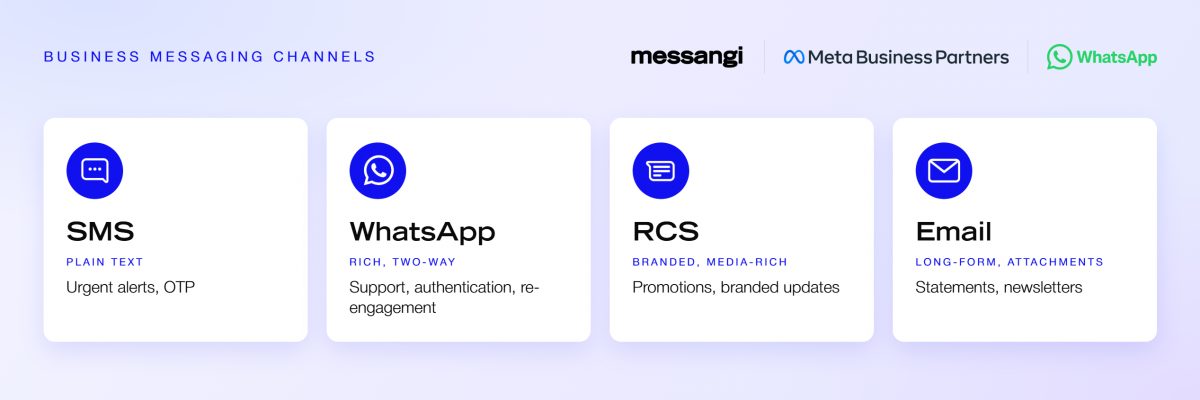
SMS reaches any phone, WhatsApp enables rich two-way chats, RCS adds branded media, and email carries detailed content.
The right business messaging channel depends on the message, the audience, and the market.
Key Takeaways
- SMS reaches every mobile phone and suits short, urgent alerts.
- WhatsApp supports rich, two-way conversations but requires an accredited provider to operate at scale.
- RCS brings branded, media-rich messaging over the carrier network where operators support it.
- Email suits detailed, high-volume communication and is generally the most economical option.
What is SMS, and when should a business use it?
SMS is the oldest messaging channel, yet it still earns its place in enterprise programs. It reaches any mobile phone, with no app or internet connection required. That reach is why so many critical alerts still travel by text. SMS is also typically read within minutes, which suits time-sensitive messages.
- Trusted for security: banks rely on SMS for one-time passwords and fraud warnings, where speed matters most.
- Operational updates: retailers use it for order confirmations and delivery notices that customers act on quickly.
- Universal reach: because SMS needs no app, it also reaches feature phones and low-connectivity areas.
- Plain by design: it carries only text, so it trades rich formatting for broad reach.
For short, urgent messages that must reach any phone, SMS remains a strong fit.
What is WhatsApp Business, and what does it require?
WhatsApp is one of the most widely used conversational channels in Latin America. The channel supports two-way chats, images, documents, and quick-reply buttons in one thread. So a customer can confirm an order or ask a question without leaving the conversation. Two-way chat also lets support teams resolve simple requests without a phone call.
- Official account: business use needs a WhatsApp Business Account, or WABA, not the consumer app.
- Accredited provider: scaling means working through an accredited provider, because WhatsApp controls onboarding and access.
- Approved templates: every business-initiated message needs an approved template before it can be sent.
- Consent first: opt-in is mandatory, and WhatsApp bills per message, with rates set by category and country.
Proper onboarding matters, however, because a rejected template or missing consent stalls a campaign.
What is RCS, and where is it available?
RCS, or Rich Communication Services, upgrades SMS directly over the carrier network. It adds branded sender names, images, carousels, and suggested replies. Unlike WhatsApp, it needs no separate app, because it runs in the phone’s native inbox.
- Branded experience: verified sender names and logos help customers recognize the sender at a glance.
- Rich formatting: carousels, images, and suggested replies turn a plain text into an interaction.
- Operator-dependent: availability varies, since each carrier and device decides RCS support.
- Varying footprint: availability differs by country and operator, and support continues to grow.
RCS suits brands that want richer messaging without asking customers to install anything.
What role does email play in a messaging strategy?
Email remains the workhorse for detailed, high-volume communication. It carries long content, attachments, and statements. It rarely drives urgent action, however, because messages can sit unread for hours.
- Depth and record: email handles statements, receipts, and newsletters that customers save and search.
- Low cost: email is generally the most economical option for high-volume communication.
- Reputation-driven: deliverability depends on sender reputation and clean, consented lists.
- Best as a complement: a statement goes by email, and the ready alert goes by SMS or WhatsApp.
How do SMS, WhatsApp, RCS, and email compare?
Each channel fits a different message, audience, and budget. The table below summarizes the core differences, and the sections above explain the trade-offs.
| Channel | Reach | Format | Best for | Requirement |
| SMS | Any mobile phone | Plain text | Urgent alerts, OTP | Sender registration |
| WhatsApp users | Rich, two-way | Support, authentication, re-engagement | WABA + accredited provider | |
| RCS | Supported carriers and devices | Branded, media-rich | Promotions, branded updates | Operator support |
| Any inbox | Long-form, attachments | Statements, newsletters | Consent + sender reputation |
Why do these differences matter for cost and compliance?
Channel choice is not only about richness; it also shapes cost and compliance. Each channel carries its own billing model and its own rules by market. Cost also depends on volume, message type, and destination country, so comparisons work best per use case.
- SMS billing: charged per message segment, and many markets require sender registration first.
- WhatsApp billing: charged per message, with rates set by category and country.
- RCS and email: RCS pricing varies by operator, while email is generally the most economical but depends on reputation.
- Market rules: in the United States, A2P SMS requires 10DLC registration, while other markets set their own sender rules.
Understanding these differences early helps avoid blocked traffic and unexpected costs later.
What consent and opt-in rules apply to each channel?
Consent is the foundation of compliant messaging, and every channel requires it before the first send. Rules differ by channel and by country, so records must show when and how each customer agreed. Legal teams should confirm local requirements.
- SMS: in many markets, opt-in is collected at signup or checkout, with a clear description of message types.
- WhatsApp: explicit opt-in is required before any business-initiated template message reaches a customer.
- RCS: sender and brand verification follow the carrier’s rules for the market.
- Email: clear opt-in and an easy unsubscribe are common requirements, and they keep lists healthy.
A single consent record, stored and timestamped, keeps every channel aligned and auditable.
How can a business combine these channels effectively?
No single channel fits every message, so a layered approach works better than one default. The key is to keep consent and contact data in one place. That way, each message uses the right channel automatically. A simple rule helps. Urgent messages go to SMS, and conversations go to WhatsApp. Branded content goes to RCS, and detailed content goes to email.
- Retail: promotions by RCS, order confirmations by SMS, and support conversations by WhatsApp.
- Banking: OTPs by SMS, statements by email, and service chats by WhatsApp.
- Unified data: shared consent and contacts prevent duplicate or mistimed messages across channels.
- Match to intent: each message is aligned to urgency, richness, and cost before it is sent.
This is where one multichannel platform earns its value.
How does Messangi bring the four channels together?
Managing four channels across separate tools creates fragmentation, and campaigns slow as data scatters. Messangi brings SMS, WhatsApp, RCS, and email into one Communications Platform. So teams work from a single source, rather than stitching tools together.
- Shared records: Contacts, Message Templates, and Consent Management live in one place.
- Cross-channel sending: Broadcast sends one-to-many messages through enabled Channels, while Automations and Live Chat handle two-way interactions.
- Unified reporting: Analytics & Reporting show performance in a single view.
- Guided WhatsApp: Messangi holds official WhatsApp for Business Technical accreditation as a Select Business Partner and guides WABA onboarding.
More than 300 companies send messages through Messangi. The company brings direct operations in Colombia and Venezuela and more than two decades in the region.
Frequently Asked Questions (FAQs)
Which messaging channel suits urgent alerts best?SMS usually does, because it reaches any phone and is typically read within minutes.
Does my business need approval to use WhatsApp?Yes, WhatsApp business use requires a WhatsApp Business Account and an accredited provider.
Is RCS available everywhere?
No, RCS availability depends on the mobile operator and the device.
Can email replace SMS or WhatsApp?
No, email complements them but rarely drives the urgent action those channels deliver.
Should a business use one channel or several?
Most businesses benefit from combining channels, matching each message to its urgency and format.
Conclusion
SMS, WhatsApp, RCS, and email each solve a different messaging need.
The right channel depends on reach, cost, richness, and market rules.
A combined, well-managed approach fits most programs better than a single default channel.
Messangi unifies all four channels in one platform for the Americas.