Introduction
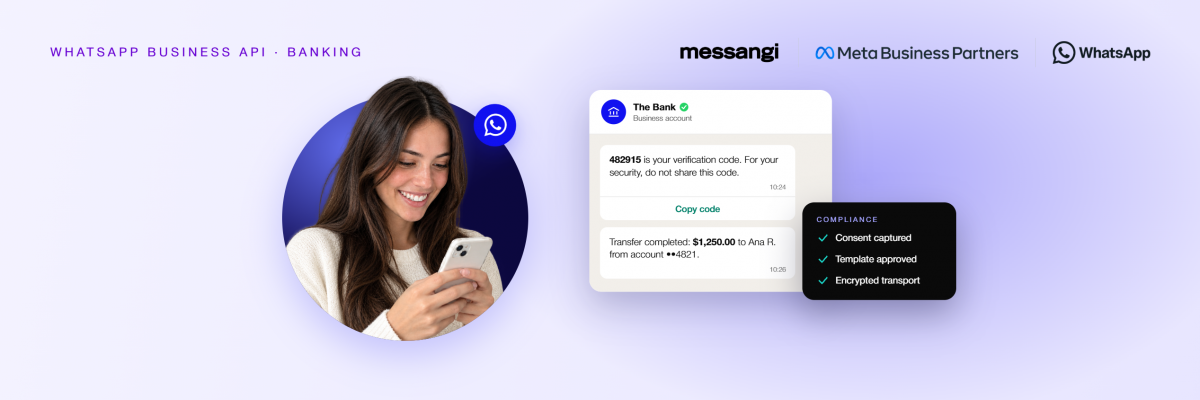
The WhatsApp Business API lets banks send interactive messages at scale.
It supports authentication, alerts, and customer service in one channel customers already use.
Adoption depends on explicit consent, template approval, and careful data handling.
For banks, the API brings conversational service together with the compliance the sector demands.
Key Takeaways
- The WhatsApp Business API enables banks to authenticate users and send transactional alerts.
- Every business-initiated message requires an approved template and explicit customer consent.
- WhatsApp supports authentication, alerts, and two-way service in a channel customers already use.
- Banks need an accredited provider to manage onboarding, templates, and compliance.
What is the WhatsApp Business API?
The WhatsApp Business API is WhatsApp’s channel for messaging at scale, and it differs from the consumer app. It connects to a bank’s systems through a provider, rather than a phone. So it can automate alerts, power two-way chats, and link to customer records.
- Built for scale: it runs through a WhatsApp Business Account, or WABA, not a personal app.
- System-connected: it links to a bank’s own systems through APIs and an accredited provider.
- No native inbox: the API itself has no chat screen, so a platform provides one.
- Automation-ready: alerts and flows can trigger from account events.
Why are banks adopting WhatsApp?
Banks face pressure to reach customers on familiar channels, and WhatsApp fits. It is one of the most widely used conversational channels in Latin America. Because many customers use it daily, the entry point is familiar.
- Familiar channel: many customers use WhatsApp daily, so a bank message meets them where they already are.
- Trusted thread: customers read bank messages in an app they already know.
- Service and security: one channel can handle both support and authentication.
- Cost-aware: authentication pricing on WhatsApp varies by country, so banks compare it per market.
What are the main banking use cases?
Banks apply the channel across security, service, and lifecycle messaging.
- Authentication: one-time passwords and login verification through a familiar channel.
- Transaction alerts: notifications for payments, transfers, and card activity.
- Fraud warnings: alerts when suspicious activity is detected.
- Customer service: two-way support for balances, disputes, and account questions.
- Reminders: payment due dates, statement availability, and renewals.
- Onboarding: guided steps for new accounts and product activation.
How does WhatsApp handle authentication and OTPs?
Authentication is a core banking use case, and it follows a clear, consent-based flow. Each stage depends on the one before it.
- Consent: the customer opts in to receive messages on WhatsApp.
- Template: an approved authentication template carries the one-time password.
- Delivery: the code arrives in a familiar thread inside the customer’s WhatsApp.
- Verification: the customer enters the code, and the login completes.
Templates that follow WhatsApp’s rules keep this flow predictable.
What compliance and security requirements apply?
Banks assess messaging against their own security and regulatory requirements. Approved templates, stored consent, and an accredited provider are baseline controls.
- Consent capture: opt-in must be stored before any message is sent.
- Secure data: customer data should move through encrypted, access-controlled systems.
- Category rules: content must match the template category for each message.
- US registration: A2P SMS in the United States requires 10DLC brand and campaign registration.
How do templates and consent work?
WhatsApp business-initiated messages start from approved templates, and consent gates every send. A rejected template or a missing opt-in stops a campaign, so management matters.
- Template categories: authentication, utility, and marketing each follow their own rules.
- WhatsApp approval: every template needs review before it can be used.
- Opt-in required: consent must exist before a bank messages a customer.
- Ongoing upkeep: well-managed templates and consent keep campaigns moving.
How do banks scale WhatsApp messaging safely?
Scaling requires planning, because quality ratings affect how much a number can send.
- Approved first: templates clear review before high-volume sends.
- Quality watch: relevant, expected messages protect the sender rating.
- Consent upkeep: opt-in stays current and easy to withdraw.
- Early monitoring: delivery and quality issues surface before they grow.
How does WhatsApp compare to SMS for banking?
Banks often weigh WhatsApp against SMS for critical messages, and both have a role. SMS reaches any phone and needs no app, so it remains a dependable option where WhatsApp is unavailable. WhatsApp adds rich formatting and two-way replies for customers who use the app. The SMS vs WhatsApp vs RCS vs email comparison covers all four channels.
- Reach: SMS reaches every phone, while WhatsApp reaches its large active user base.
- Richness: WhatsApp supports buttons and media, while SMS stays plain text.
- Coverage: SMS covers cases where WhatsApp is unavailable or not opted in.
- Better together: many banks use both, matched to each message type.
What changes for banks from country to country?
Banking messaging rules and provider expectations differ by market, so regional detail matters. A multi-country bank confirms requirements market by market.
- United States: A2P SMS requires 10DLC brand and campaign registration, so banks that pair WhatsApp with SMS plan registration early.
- Colombia: banks can weigh a provider’s local operations, direct connectivity with major operators, and local-currency billing.
- Venezuela: local billing and direct operator connectivity are relevant factors when banks compare providers.
- Other markets: sender rules and WhatsApp availability vary by country, so each launch needs its own review.
What data and privacy safeguards should banks look for?
Data protection sits at the center of banking messaging, so safeguards come first. Banks review each provider against their own security policies. Audit trails, moreover, support internal and regulatory reviews.
- Encrypted transport: connections should protect customer data in transit.
- Access controls: only authorized roles should send or view messages.
- Consent records: opt-in should be documented for each customer.
- Minimized content: sensitive details should stay out of message bodies where possible.
- Audit trails: activity logs should support internal and regulatory review.
How do banks measure WhatsApp performance?
Measurement shows whether the channel meets its goals, so reporting matters. Delivery and read data indicate how messages perform, while response rates reveal engagement. Cost per message, in turn, helps compare channels fairly.
- Delivery and reads: show whether messages arrive and get seen.
- Response rates: reveal engagement on two-way flows.
- Resolution times: show the impact on customer service.
- Unified reporting: keeps WhatsApp, SMS, RCS, and email in one view.
How does Messangi support banks on WhatsApp?
Messangi holds official WhatsApp for Business Technical accreditation as a Select Business Partner. So it guides banks from onboarding through daily operations. It supports WABA setup and template submission on one platform.
- Onboarding: guided WABA setup and template submission from an accredited partner.
- System connection: Integrations (APIs and webhooks) connect authentication and transactional alerts to a bank’s systems.
- Two-way service: Live Chat supports agent handoff for complex cases.
- Unified view: Analytics & Reporting track delivery and engagement across channels.
- Country depth: direct operations in Colombia and Venezuela, with local billing. Messangi is registered with the CRC in Colombia and is a registered messaging operator in the United States.
Banks can also combine WhatsApp with SMS, RCS, and email in one place. More than 300 companies send messages through Messangi. The company brings more than two decades in the region.
Frequently Asked Questions (FAQs)
What is the WhatsApp Business API used for in banking?
It sends authentication, transaction alerts, and customer service messages through WhatsApp.
What should banks check before using WhatsApp?
Banks check consent capture, template approval, data safeguards, and provider accreditation against their own requirements.
Can my bank send OTPs over WhatsApp?
Yes, one-time passwords can be sent using approved authentication templates.
Does WhatsApp banking require customer consent?
Yes, explicit opt-in is required before any business-initiated messaging begins.
How do banks start using the WhatsApp Business API?
Banks work with an accredited provider to set up a WABA and approve templates.
Conclusion
The WhatsApp Business API gives banks a messaging channel for authentication, alerts, and service.
It operates under strict consent and template rules.
Templates, consent, and accreditation are essential to adoption.
Messangi helps banks across the Americas adopt WhatsApp properly.